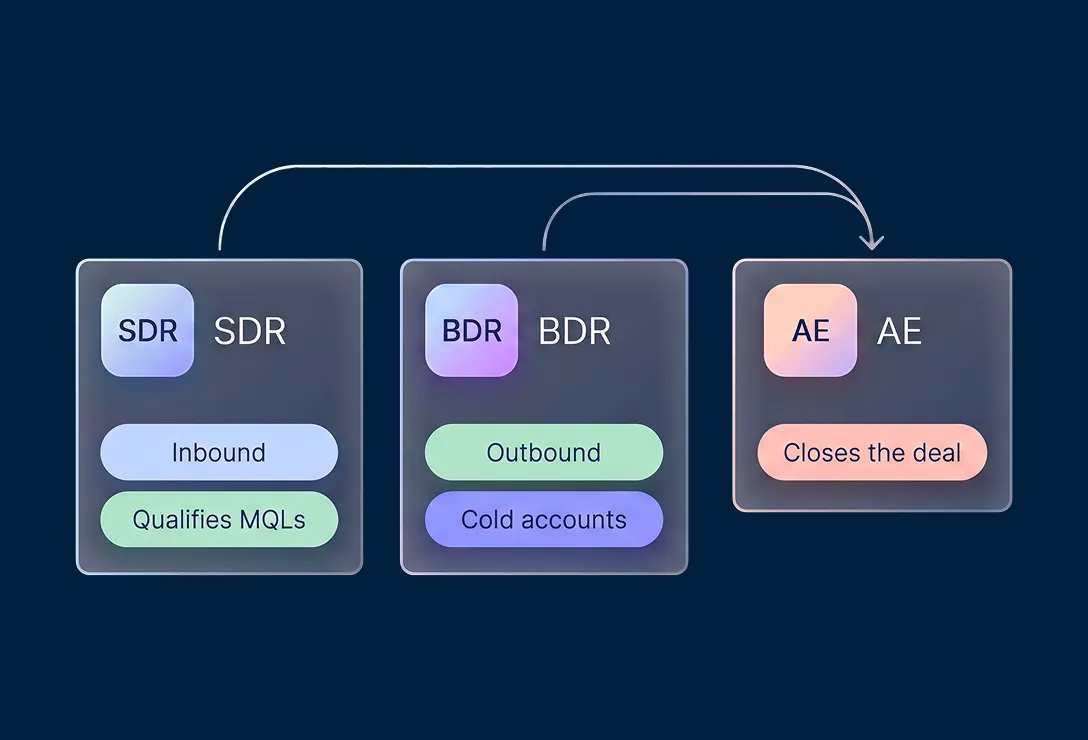
SDR vs BDR comes down to one thing: direction. An SDR qualifies the inbound leads marketing creates. A BDR sources outbound pipeline by prospecting cold accounts. Both book qualified meetings for AEs, and plenty of teams interchange the titles. What actually decides how well either performs is the data they work from and the timing of their outreach.
The short version: an SDR works inbound, a BDR works outbound. An SDR takes the leads marketing creates, through content, ads, and events, and qualifies them to decide which deserve a meeting. A BDR works from a target list built on the ICP, reaching cold accounts to create pipeline that did not exist.
Both are sales development roles. Both sit at the top of the funnel. Both exist to book qualified meetings for Account Executives. The split is about where the lead comes from, not seniority or skill. The real difference is the direction of the motion. That is the whole SDR/BDR difference in one line, and most of the confusion online comes from teams that use the two titles interchangeably.
An SDR (Sales Development Representative) qualifies inbound demand. Their day is built around leads that already raised a hand: a demo request, a content download, a webinar signup. They research the lead, confirm it fits the ICP, gauge intent and timing, then either book a meeting or route it back to nurture. The SDR's edge is speed and judgement. Reach a warm lead fast, and separate real buying interest from idle curiosity before an AE's calendar gets spent on it.
A BDR (Business Development Representative) creates demand that does not exist yet. They build a target list from the ICP, find the right people at each account, and reach them cold through calls, email, and social. Nobody asked them to get in touch, so relevance is everything. The BDR who reaches the right person at the moment something changes, with a strong 'why now' reason, books the meeting. The BDR who blasts a stale list does not.
SDRBDRPrimary motionInboundOutboundLead sourceMarketing-generatedSelf-sourced from the ICPStarting pointA lead that raised a handA cold account from a target listCore skillFast qualificationCold prospecting and relevanceSuccess metricQualified meetings from inboundQualified meetings from outboundBooks meetings forAEAE
A note on titles: these are the common conventions, but plenty of teams reverse them or use one title for both motions. What matters is that someone owns inbound qualification and someone owns outbound creation. If the same person does both, they are simply wearing two hats.
Development reps and closers are different jobs, and knowing the line matters more than the title. An SDR or BDR books the first meeting; an Account Executive (AE) runs the deal from there to closed-won. The SDR vs AE difference is the one people ask about most, but the same line separates a BDR from an AE: development books meetings, closing owns revenue. One fills the top of the pipeline, the other works it down.
Picture the flow as a relay. Marketing and the BDR create the opportunities, the SDR qualifies the inbound ones, and both hand a booked meeting to the AE who carries it the rest of the way. Get the split right and each person does the job they are good at. Blur it, and you get AEs prospecting between calls or SDRs sitting in late-stage deals they were never set up to run. For the wider picture of how these stages connect, see what B2B sales looks like end to end.
Both roles exist to feed AEs clean, qualified meetings, and the handoff is often where pipeline quietly leaks. A meeting booked on a half-empty contact record forces the AE to re-research the prospect or walk in blind. Multiply that across a quarter and it is real revenue lost to admin.
The quality of the record passed up the line decides how well the AE performs: complete firmographics, a verified work email and mobile, and the reason the meeting was booked. That last part matters more than it sounds. The trigger is everything: a funding round, a new hire, a tool switch mentioned on the call. An AE who walks in knowing it has a reason to be in the room; one who doesn't is starting cold. Gartner has found B2B buyers spend only a small share of the buying journey with any sales rep, so the little time an AE gets has to count (Gartner). Development reps who hand over enriched, context-rich records make the whole team faster. Reps who only hand over a name and a company make everyone slower.
There is no single right org chart, but the patterns are consistent. Smaller teams start with one blended development rep who does both motions, because the volume does not yet justify a split. As inbound grows, an SDR function forms to catch it. As leadership decides to create pipeline rather than wait for it, a BDR function forms alongside. Both usually report into a sales development or BDR manager, who reports into sales leadership, not marketing, even though the SDR works marketing's leads.
Ratios are where planning gets real. Teams generally run more development reps than closers as they scale, and the balance between SDRs, BDRs, and AEs shifts with how much of the pipeline is inbound versus outbound. The Bridge Group's long-running SDR research is the standard reference for benchmarking those ratios and ramp times before you hire. The honest read: staff to your actual lead mix, not to a template. A team with strong inbound and thin outbound needs SDRs first; the reverse needs BDRs first.
One shift worth naming in 2026: AI SDR tools now handle a slice of the mechanical outbound a junior BDR used to own, building lists, drafting first-touch emails, sequencing the follow-ups. They are fast, but they are blind without a data brain telling them who to reach and why. So the human roles have not gone anywhere; they have moved up the value chain. Reps now spend less time on the busywork and more on the parts only a human can do: judging which accounts are actually worth the effort, reading a prospect on a live call, and building the trust that closes a complex deal. Targeting and timing still decide who books the meeting. Software just makes the mechanics faster underneath.
Outdated models measure motion: dials and sends. The modern one measures relevance. Whether the rep works inbound or outbound, the winning workflow is the same in shape:
This is where the roles stop being a definitions debate and start being an execution problem. Reps lose 20 to 30% of the day chasing contact data, and that time comes straight out of selling. Surfe is the Pipeline Generation Platform that runs that loop in one place, which is part of why one Google team sources 80% of its new contacts with it. The point is not only more activity. A well-built, well-timed list beats a high dial count on a bad one every time. You cannot out-dial bad data, and no amount of SDR-versus-BDR org design fixes a list nobody should be calling.
If you have strong inbound and leads are slipping through unqualified, hire an SDR. If your inbound is thin and you need to create pipeline, hire a BDR. Most scaling teams end up with both, split by motion, feeding a shared pool of AEs.
One rule holds either way: do not hire either before you have a defined ICP and clean data to work from. A development rep handed a bad list will look like a bad hire when the real problem is upstream. Fix the targeting and the data first, then add the seat.
SDR or BDR, inbound or outbound, the title matters far less than what you hand the rep to work with. Get the ICP right, enrich every contact into a verified email and mobile, and reach accounts the day a signal fires. Do that and both roles book more meetings without more dials, because the work stops being about activity and starts being about relevance. That is the loop Surfe runs in one place, from the first list to the record the AE closes.
See how Surfe gives SDRs and BDRs verified contacts and buying signals in one workflow. Start free.
What is the difference between an SDR and a BDR? An SDR qualifies inbound leads from marketing; a BDR sources outbound pipeline by prospecting cold accounts. Both book qualified meetings for AEs, and the split is about motion, not seniority.
What does SDR stand for? Sales Development Representative, typically focused on qualifying inbound demand.
What does BDR stand for? Business Development Representative, typically focused on outbound prospecting to create new pipeline.
Are SDR and BDR the same thing? They overlap, and many teams use the titles interchangeably. The convention is SDR for inbound, BDR for outbound, but the split varies by company, so the responsibilities matter more than the label.
What is the difference between an SDR and an AE? An SDR books the first qualified meeting; an Account Executive runs the deal from that meeting to closed-won. SDRs are measured on meetings booked, AEs on revenue closed.
How many SDRs or BDRs does a team need? It depends on your inbound-versus-outbound mix. Teams generally run more development reps than closers as they scale; benchmark ratios and ramp with a source like The Bridge Group, then staff to your actual lead mix.
Which should I hire first, an SDR or a BDR? Hire an SDR if strong inbound is going unqualified; hire a BDR if you need to create outbound pipeline. Define your ICP and clean your data first either way.
Henry Burns focuses on revenue growth, strategic partnerships, and new market opportunities. He has held roles in leadership and client engagement, and specialises in go-to-market strategies that accelerate pipeline and strengthen long-term business relationships. He works closely with internal teams and external stakeholders to build growth that lasts. Born in the UK. Based in New York.
Your most pressing questions, answered with clarity.
%201%20(1)%20(1).avif)