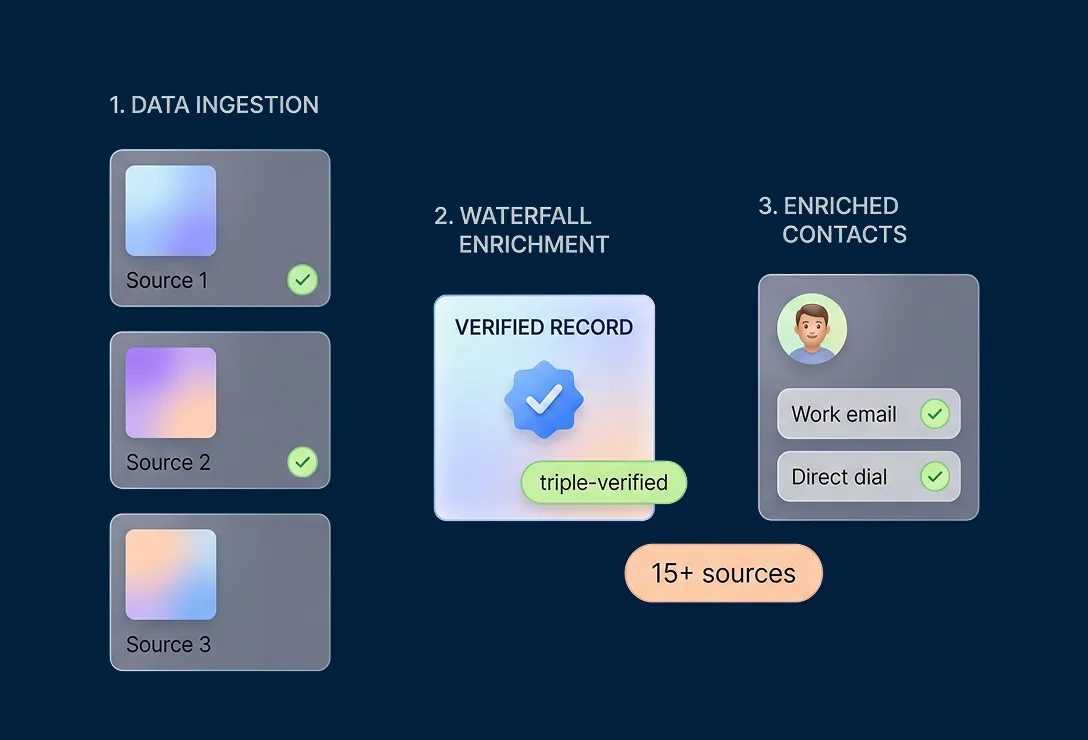
Waterfall enrichment cascades through 15+ data sources, cross-checking every email and mobile before it lands in your CRM. That layered, verified approach hits a 93% find rate worldwide, so your teams work from data they can trust. Fewer bounces, more conversations, more pipeline.
Waterfall enrichment is a method for finding and verifying B2B contact data by cascading across many providers rather than trusting just one. You request a person's verified work email or mobile, the system checks the first source, and if there is no confirmed match, it checks the next, and the next, until it returns a verified result. That ordered cascade is the “waterfall”: each provider catches what the one above it missed.
Compare it to a single-source lookup, where you get whatever that one database contains, or nothing at all. A data waterfall gets you the best available answer from many databases in a single query. The term you will also see for this is multi source enrichment, and it is the same idea: stop betting your pipeline on one vendor's coverage.
The reason it matters is simple. Enrichment only helps if the record is right, and the record is only right if the person you are trying to reach is actually in the database you checked. A waterfall raises the odds that they are, because it checks many more sources.
Because no single database ever held the whole market. Each one runs deep in the territory its vendor chased and thin everywhere else, a map with rich detail in one corner and blank space across the rest. A high accuracy score only promises the filled-in part is drawn right. It says nothing about the blank space where your next buyer actually sits. And that blank space is exactly what you hit at 4 PM on a Tuesday.
These gaps are not secret. The big single-source databases all work the same way: ZoomInfo, Apollo, Cognism, and Lusha serve you their own records, so you inherit their coverage and their blind spots, strong in one region or data type and thin in the next. That does not make them bad tools. It makes them incomplete ones, and incompleteness is a coverage problem no amount of “accuracy” fixes.
This is also where Surfe plants a flag. Data should never be a black box. You should be able to see which sources were checked, which one answered, and how the result was verified, because opacity is the exact frustration Surfe was built against. Multi source enrichment is the practical version of that belief: layer the providers, show your work, and return the best verified record instead of one vendor's guess.
A waterfall enrichment query runs in four moves:
Source order is the part most people underrate. The best source is not the same for every search: the provider most likely to hold a verified French mobile is not the one most likely to hold a US enterprise email. Good waterfall data enrichment ranks its providers by what the input suggests and hits the highest-probability source first. That is the difference between “we have 15+ sources” and “we select the most reliable source for your specific search.” The second one is what actually raises the find rate, and across those 15+ sources it lands at a 93% find rate, the same 93% every time, worldwide.
Single-sourceWaterfallCoverageOne database's recordsBest of many databasesFind rateCapped by one vendor's gapsHigher, gaps filled by fallbackVerificationOften single-sourceConfirmed across 3+ sourcesRegional strengthUnevenBalanced by orderingResilienceOne provider down, query failsFailover to the next sourceCost efficiencyOne vendor's bill, one vendor's gapsOne credit per verified contact, however deep it digs
Two variables decide whether a search returns a verified record: where the person is, and what you asked for. Coverage is uneven across regions because each provider has a home turf and a falloff beyond it. That is the whole case for cascading: a US-strong source covers your American accounts while an EMEA-strong source fills the European ones, so coverage stays roughly steady as you cross borders instead of dropping off a cliff at the edge of a vendor's home market. For the full provider-by-region picture, see the best B2B data providers.
Data type matters just as much. Emails are abundant and easy to verify. Mobiles are not. They are scarcer, and they change more often. Independent benchmarks consistently put mobile fill rates well below email for the same provider. No single phone database covers much more than half of B2B professionals, so a headline “90% accuracy” often means a high email rate hiding a much lower mobile rate. A waterfall is the honest answer to that gap, because layering sources is the only way to push mobile coverage up toward where email already sits.
The proof is in the numbers real teams see. One Amazon team went from single-vendor coverage holes to roughly a 90% average find rate by cascading across sources, exactly because the fallback caught what any one provider missed. No single database, however good, matches what several do together, and Surfe runs that cascade natively inside its Pipeline Generation Platform and as the enrichment engine embedded in CRMs like HubSpot and Pipedrive.
No, you do not need to hire a team of engineers to build your own waterfall. Contracting 15+ providers, integrating each API, and babysitting the failover logic is months of work plus permanent vendor management, and it is not the job you are trying to do. A solution, like Surfe, runs the cascade for you. Just connect your CRM, and enrichment happens automatically and in bulk, with zero engineering tickets to set it up. The best enrichment is the one your reps never notice, because it happens inside your workflows and keeps the CRM current instead of becoming a project to maintain. Your team starts to look like it has a sixth sense. It is just better data, working before anyone asks.
That last point matters because a waterfall fixes coverage, not decay. B2B contact data goes stale at roughly 22% a year as people change roles and companies move, per HubSpot's database decay research, and that quiet erosion drains pipeline whether or not anyone is watching. Surfe is watching. Its Signals feature monitors your connected CRM contacts automatically and catches a job change the day it happens, so records stay current as people change roles. The full method is in why your CRM contacts are wrong.
Somewhere in your market, the buyer you want changed jobs last quarter and picked up a new phone number. One database never noticed. A waterfall did. Surfe cascades 15+ sources, verifies every record, and drops that contact in your CRM while a single-source competitor is still dialing a disconnected line. Let the competition chase bad numbers. You chase revenue. Start free.
What is waterfall enrichment? A method that queries multiple data providers in sequence for the same contact, cascading until one returns a match, then confirming it across several sources, returning a higher find rate than any single database.
Why is waterfall enrichment better than a single database? Every database has gaps by region, seniority, and data type. A waterfall fills them by falling through to the next source, so coverage and find rate rise above any one provider.
How does a data waterfall work? It checks providers in a tuned order, moving to the next whenever one comes up empty, then confirms the result across 3+ sources before it reaches your CRM.
Does source order matter in a waterfall? Yes. The most reliable source differs by region, seniority, and data type. Ordering by the input hits the best provider first, so more searches return a verified match.
Is waterfall enrichment more accurate? It is more reliable than single-source because each result is confirmed across several sources before delivery, which cuts bounces and wrong numbers rather than trusting one vendor's claim.
How should I compare waterfall enrichment tools? Ignore headline accuracy figures and test find rate on your own list, split by region and by email versus mobile, then check how each tool verifies a record and how often it refreshes.
Do I need to build my own waterfall? No. A solution runs the cascade behind one integration, so you get many providers, native failover, and continuous updates without contracting and maintaining each one yourself.
Maged Elhadad was Surfe's first employee, hired to build the product function from scratch. Today, he leads strategy across the entire Surfe solution, from the enrichment engine to the integrations and workflows on top of it. He designs for how GTM teams actually work, paying close attention to the workarounds customers create when a product falls short. Born in Egypt. Based in Paris. Former swimming coach. Basically Aquaman 🐠
%201%20(1)%20(1).avif)