
TL;DR
Choose a narrow group of buyers, read each profile before you write, and send invitations by hand with a reason that's about them. Once someone replies, put them in your CRM with a verified email and phone and a dated next step. Then watch for job changes, because the person who moves is both a stale record and a new lead.
The conversation went well. She asked for a deck, you said you'd send it Thursday, and Thursday you were on a different account. Three months later she's at a new company and the thread lives in your inbox, nowhere else.
Most prospecting advice stops at the reply. The pipeline gets lost after it. Here's the workflow in five steps: choose a narrow group, research each person, send a real invitation, log the reply in your CRM, and watch for job changes.
How do you find leads on LinkedIn™?
Start narrow, with one kind of buyer at one kind of company. For example: heads of sales ops at software companies with 200 to 1,000 people, in one region. Define the role, the company size and the region before you search, then stop at a list you can work properly this week.
Two habits keep the list honest.
- Read past the title. "Head of Revenue" means four different jobs at four companies, so open the profile and the company page before anyone goes on the list.
- Look sideways. When one person fits, look at the others at that account. Surfe's panel suggests similar profiles at the same company, which is quicker than starting a new search.
What should you research before you send anything?
One thing about them, not you: a post they wrote, a hire they announced, a role they started recently, a mutual connection you can name. Two minutes a person is enough. If you can't say why your offer fits their role, leave them off this week's list.
Timing helps. Data published on the LinkedIn™ sales blog says members who changed organisations in the past three months are 62% more likely to accept an InMail. A new role comes with a mandate to fix things, which is why signal-based prospecting starts there.
How do you send an invitation without getting restricted?
Send each invitation yourself, with a short note that explains why you want to connect. Section 8.2 of the LinkedIn™ User Agreement prohibits bots and unauthorised automated messaging, and invitations are capped. The exact limits aren't published; our LinkedIn™ limits guide lists the thresholds users commonly report.
Here's the kind of note that works, because it's about them:
Saw your post on moving the SDR team onto one sequencer. How are you handling contact data during the move? Happy to compare notes if useful.
No pitch and no calendar link. If they accept and reply, keep talking there. If they accept and go quiet, an email is a fair next step, with a reason to write that wasn't in the first note.
When should a prospect go into your CRM?
As soon as there's a real exchange: a reply, an accepted invitation with a conversation, a meeting booked. Waiting until it's an opportunity means the history lives in one rep's inbox, and it leaves when they do.
- Open the profile and check whether the person is already in the CRM. If they are, update that record.
- Add them as a Contact or a Lead, depending on how your team uses the two.
- Add a work email and mobile. Surfe finds both from the profile and validates them first (85% accuracy on emails, 80% on mobiles).
- Write the next step on the record while it's fresh: what you talked about, what you promised, and the date you'll follow up.
A reply nobody logged is a rumour.
If you're still choosing how to connect the two tools, which CRM works best with LinkedIn™ compares the routes.
How do you keep prospects current after the first conversation?
Watch for job changes. When someone moves, the CRM record goes stale and your champion becomes a warm lead at a new company, both on the same day.
Surfe checks the contacts in your CRM every day and flags the ones whose title or company changed. You review each change and update the record in one click. Sales Navigator also alerts you to job changes for leads you've saved there.
What should you never automate?
The first message, and the choice of who gets one. Let tools handle the admin: logging the contact, finding the email, setting the task, flagging the job change. Review every recipient and every message yourself before you send.
Start with ten people this week. Research each one, write to each one, and log every reply the day it arrives.
Prospect from the profile, log it in your CRM
See how Surfe worksSources
- What CRMs integrate with LinkedIn™ Sales Navigator, and why integrate them (LinkedIn™ Sales Blog, February 19, 2024)
- Compare Sales Navigator plans (LinkedIn™ Corporation, November 17, 2026)
- LinkedIn™ User Agreement, section 8.2 (LinkedIn™ Corporation, November 3, 2025)
FAQs
Do I need Sales Navigator to prospect on LinkedIn™?
No. Standard search works for a small territory. Sales Navigator adds saved searches, more filters, lead alerts and InMail. Compare Core and Advanced against the features you need; Advanced Plus is the plan that adds CRM Sync.
How many connection requests should I send a week?
LinkedIn™ doesn't publish exact limits. Our LinkedIn™ limits guide collects the thresholds users commonly report, and suggests staying under 100 to 150 a week. Send each one yourself, with a note.
Should I message someone on LinkedIn™ or send an email?
Usually both, in that order. An invitation with a short note opens the door; an email gives you room to explain. Log both in the CRM so the next person who calls knows what was said.

Head of BDR
Henry Burns focuses on revenue growth, strategic partnerships, and new market opportunities. He has held roles in leadership and client engagement, and specialises in go-to-market strategies that accelerate pipeline and strengthen long-term business relationships. He works closely with internal teams and external stakeholders to build growth that lasts. Born in the UK. Based in New York.
Newsletter subscribe
All our updates, straight to your inbox
Fresh articles, practical plays and product news from the Surfe team.
By subscribing you agree to our privacy policy and consent to receive updates.
Related content
Recommended reads, tailored to you
Prospecting & Outreach4 min read
How To Find A Work Email From A LinkedIn™ Profile
Four ways to find a prospect's work email from their profile, what to check with each, and what the network's user agreement and GDPR mean for your outreach.
- #email finder
- #work email

RevOps & CRM4 min read
Best CRM For LinkedIn™: Three Routes Compared
HubSpot, Salesforce, Dynamics 365 and Oracle get native CRM Sync from Sales Navigator; Pipedrive doesn't. What each route costs and what it writes to your CRM.
- #crm
- #sales navigator
Prospecting & Outreach8 min read
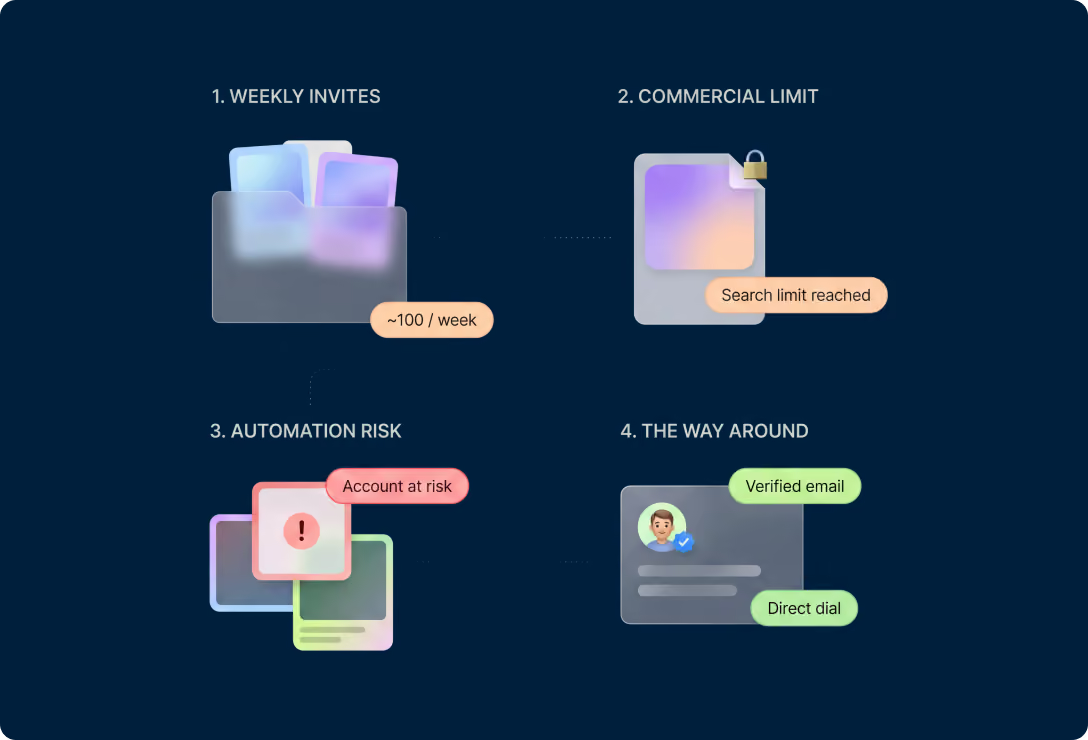
How to Stay Within LinkedIn™'s Limits
The connection, message, and profile-view limits every prospecting team runs into, why they exist, and how to work within them without risking your account.